
*This post contains spoilers*
It’s back to school season where I live, so this is the perfect time to explore a hyper-specific subgenre for horror that I love: collegiate horror. But I wanted to zoom in even closer on a specific subtype of collegiate horror that is underutilized but has a lot of potential. That is, horror movies centered on the experiences of graduate students. In some ways, graduate school already feels like a horror movie. You spend late nights in beautiful, old libraries or secluded basement laboratories learning the mysteries of the universe. Isolation, obsession, intense pressure, and existential dread are all common experiences of graduate students in real life. There’s already so much to work with, so why aren’t there more horror movies focused on graduate students? There’s a nearly unlimited collection of horror movies about the undergraduate experience (just think about all of the movies that are set in sororities), and I don’t think it’s fair that undergrads get all the glory.
I’m a PhD candidate when I’m not busy screaming horror movie hot takes into the void of the internet, so I am intimately familiar with the many horrors that arise in graduate school. The academic environment is already a setting that lends itself to multiple horror subgenres. Overwhelming stress and an obsessive drive to find answers create a perfect setting for psychological horror. The physical toll of the need to constantly perform could be a good set up for body horror. The desire to beat the competition at all costs could easily be turned into a slasher. Not to mention, who is a more fitting mad scientist than an overworked med student? I’d love to see more horror movies about grad students that embrace the unique intensity and messy, problematic qualities of the academic world. I should have been working on my dissertation, but instead, I spent my last few moments of the summer watching every single horror and horror-adjacent movie I could find about graduate and medical students. As with any other horror genre, it’s kind of a mixed bag. Some of these films are great (Candyman; Raw) and some are not so great (Death PhD; Unrest), but this is pretty much all we have to work with right now. These are just a few of the reasons why we need more horror movies about graduate students.
Too much unstructured time can get you into trouble.

Graduate students experience an odd paradox. You’re probably busier than you’ve ever been in your life, but your schedule is almost entirely unstructured. There are clear expectations that you need to meet for your program, but how and when you choose to do that is often up to you. Some people thrive with that kind of freedom, but for others, the lack of boundaries can feel destabilizing. This can spiral into obsessive fixations or self-destructive choices.
Flatliners is ultimately a movie about a group of medical students with too much time to think and not enough supervision. Driven by curiosity about the afterlife, they begin killing and resuscitating each other to see what’s on the other side. Their collective knowledge and unsupervised access to medical equipment enables them to continue pushing this dangerous experiment further and further. This concept, going too far because nobody is around to tell you not to, is a recurring theme in grad student horror movies. In Candyman, Helen’s obsession with the legend of Candyman leads her to repeatedly visit Cabrini-Green to gather information for her thesis. Unstructured time ends up being Helen’s undoing as she continues to jeopardize her own safety because nobody is around to stop her and she doesn’t have anywhere else she has to be.
This concept is similarly expressed in Grimm Love. Katie’s mounting obsession with the cannibal Oliver Hagen, whose story inspired her thesis, leads her to repeatedly engage in questionable behavior. She visits locations where he had been, breaks into his house, and begins lurking in online cannibal forums. Again, she makes her own schedule so there isn’t anyone around to stop her from putting herself in danger. This lack of structure in graduate school allows for all kinds of problematic or illegal behavior to go unnoticed. In M.F.A., Noelle begins killing rapists who never faced consequences for their actions and uses her fine arts program as a cover for her increasingly erratic behavior. When she’s out all night, she claims she was working in the art studio. When she’s covered in blood, she says it’s just paint. When a classmate sees her transporting a body across campus in the middle of the night, she tells him that it’s for an art installation.
Even when characters aren’t actively putting themselves in bodily danger, too much solitude and open-ended time create the right atmosphere for horror to occur. In Ratter, a graduate student who spends most of her time alone in her apartment becomes the target of a cyber stalker who watches her through her webcam. In Midsommar, a group of anthropology graduate students travel to Sweden to conduct academic fieldwork and it’s their lack of supervision and lack of accountability to anyone that ultimately get the group killed.
Curiosity, obsession, and the pursuit of knowledge at all costs are valued traits.
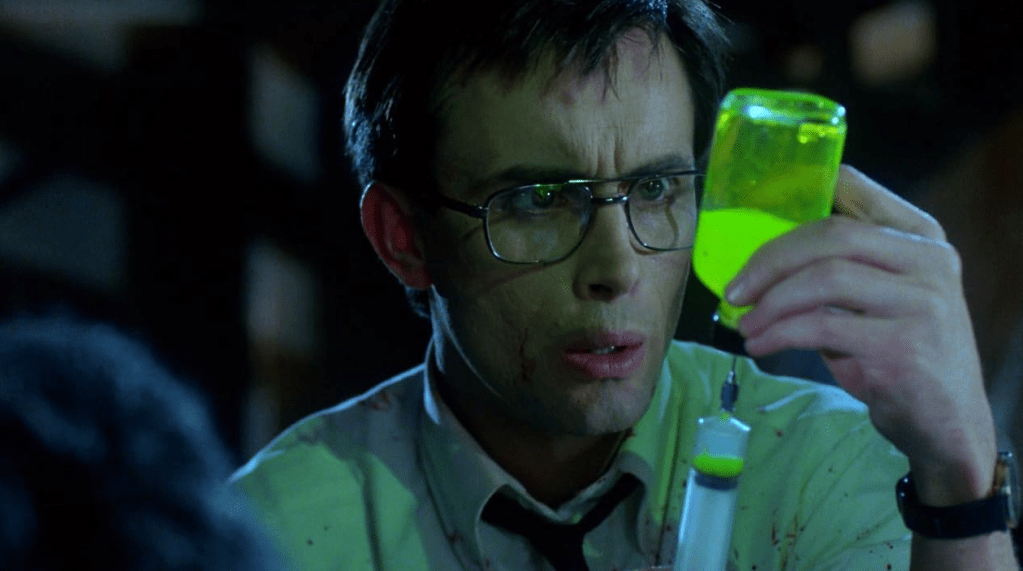
Graduate school rewards people who are insatiably curious, hyper-focused, and won’t rest until they have the answer. In academia, the relentless pursuit of knowledge is framed as an admirable quality that all should strive for, but when you push these traits to their absolute limits, they can become harmful and distorted.
Few films capture this concept better than Re-Animator. Medical student Herbert West is the personification of academic obsession. He is completely consumed with the idea of reanimating the dead and doesn’t think twice about crossing every ethical line, destroying his relationships, and putting everyone around him in mortal danger just to prove he can do it. In Unrest, a first-year medical student becomes so obsessed with learning the identity of a cadaver in her skills lab that she breaks into her professor’s office, steals confidential files, and jumps into a tank of formaldehyde (it’s relevant to the story, kind of). Her obsession with finding answers is probably what got her into medical school in the first place, but becomes incredibly problematic when taken too far.
The group of graduate students in Prince of Darkness are similarly consumed by their work. Ignoring basic needs like food and sleep, they relentlessly try to uncover the secrets of a mysterious green substance that was found in a church basement, only to unleash something apocalyptic. Flatliners also depicts the pursuit of knowledge at all costs as the characters risk their own lives over and over again just to see if they can prove the existence of an afterlife. Helen’s actions in Candyman are similarly motivated by her desire to learn more. Her fixation with documenting the story of Candyman gets her so entangled with the local urban legend that she eventually becomes part of the myth she was trying to uncover. These films remind us that academia not only tolerates, but actively encourages, obsession and the outcome can be deadly.
Academia encourages toxic competition and people can crack under the pressure to be the best.
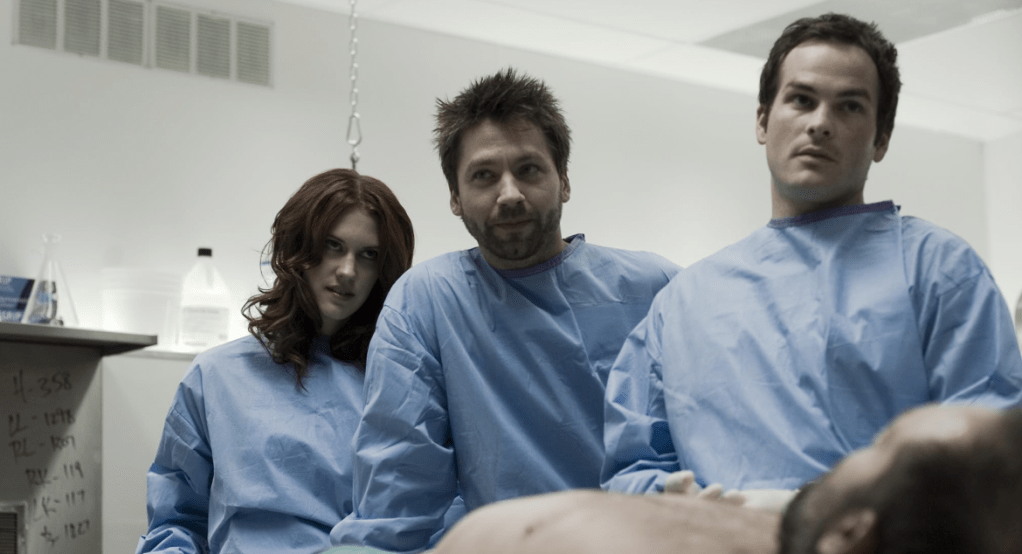
Graduate school is full of high-achievers. Many programs are fiercely competitive and only admit the best of the best. But what happens when someone who has grown accustomed to being the best is suddenly surrounded by others who are equally as impressive? Some people can’t handle the shift from feeling exceptional to feeling average, and the need to once again be the smartest, the greatest, or the most groundbreaking can become all-consuming. Horror movies in a grad school setting can take that pressure and amplify it by showing how competition can corrode morality and push people past the point of no return.
Pathology is an extreme example of how the compulsive need to prove oneself can lead to ruin. A hyper-competitive group of pathologists-in-training create a game where they each commit a murder and the others need to guess how they did it. Their drive to outdo one another escalates as their killings get increasingly more creative and sadistic. The students express no remorse for the atrocities they commit, showing how a competitive culture can normalize horrifying behavior. This is somewhat similar to the dynamic in Flatliners, except that the students in Flatliners kill themselves rather than other people. In a desire to one-up each other, they keep extending the amount of time they’ll flatline before the others revive them, making the experiences increasingly more dangerous. Competition in academia can also be isolating and destructive to interpersonal relationships. One of the primary conflicts in Midsommar occurs when Christian copies Josh’s idea for his dissertation. Christian’s betrayal ruins their friendship and pushes them both to go to increasingly drastic lengths to get the most interesting information for their respective projects, eventually leading to Josh’s death. And in Re-Animator, Herbert West’s intensely competitive nature fuels his extreme experiments, turning scientific discovery into a way for him to prove his intellectual superiority at any cost.
Desperation and the demands of completing their programs can push grad students to take dangerous risks.
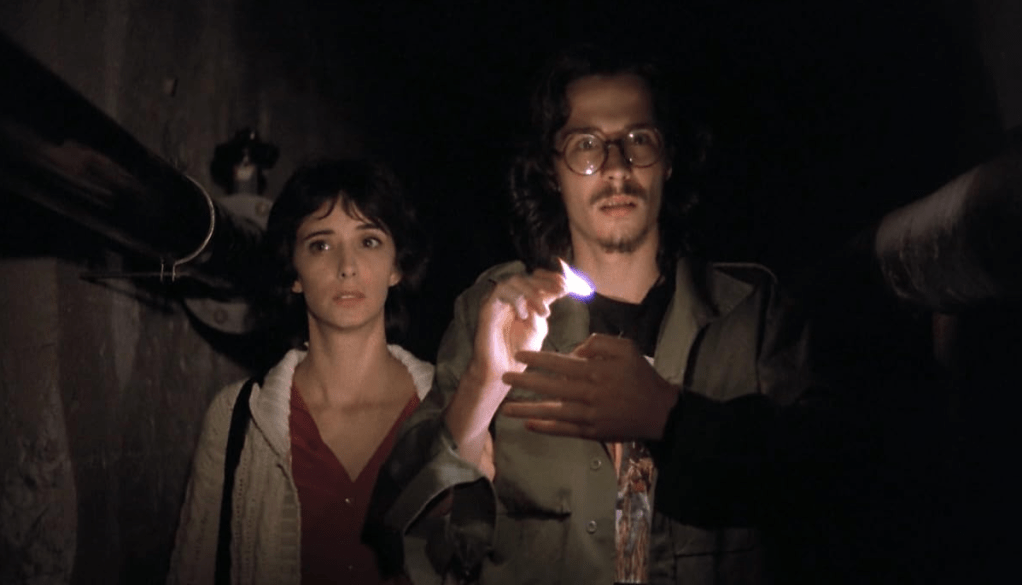
Even in the absence of an all-consuming need to be the best, desperation and the general demands of trying to complete a graduate program can drive students to take big risks. In real life, most people probably wouldn’t knowingly put themselves in extreme danger just to finish their dissertation, but horror is a great way to push this concept to the extreme. Death PhD is a comical example of the lengths people will go to to avoid needing to work on their dissertation. The movie follows a group of parapsychology PhD students who are given the opportunity to graduate early without completing a dissertation if they agree to spend an entire night in a notoriously haunted house. Unsurprisingly, most of the students agree to make that tradeoff. Look, I’m not saying I would immediately jump at the chance to risk life and limb just to avoid working on my dissertation, but I’m not not saying that either…
In the movie Thesis Ángela’s desire to finish her thesis on media violence drives her into dangerous territory. Rather than keeping her distance, she seeks out an anti-social classmate who is notorious for his collection of extremely violent banned films, hoping to access material that will make her thesis more impactful. When her thesis advisor suddenly dies while watching a graphic film she requested him to pull from the school’s private archive, Ángela steals the videotape that killed him. Presumably out of curiosity, but also because she would not be able to access such material on her own and wanted to include it in her thesis project. Her decisions are reckless, but they’re fueled by her desperation and drive to complete her thesis.
One of the biggest barriers to completing an advanced degree is the nearly insurmountable cost of graduate school. American Mary is a striking example of how the financial burden of graduate school can force people to make difficult choices. On the verge of getting kicked out of med school for defaulting on her loan payments, financial desperation leads Mary to apply for a job in a strip club to be able to pay her tuition. During her interview, someone at the club is badly injured but unable to be taken to a hospital. After learning Mary is a medical student, the club owner offers her five thousand dollars to perform emergency surgery in the club basement. This incident sets off a series of events that result in Mary getting involved in the world of extreme body modification surgeries. The overwhelming demands of graduate school creates a culture of desperation that can lead people to make choices that they might not otherwise make and this can be well utilized as a plot device in a horror landscape.
Academia was built upon the foundation of power imbalances, exploitation, and entitlement.

Exploitation and abuses of power run rampant in academic settings. Manipulation, hierarchy, and tradition can all be utilized by those with more power to take advantage of graduate students. The relationship between grad students and their advisors is extremely unique because to an extent, advisors can dictate your future. Films like Thesis and American Mary highlight how academic or professional standing can be manipulated by those in power. Students are often vulnerable to coercion, sexual exploitation, or unethical demands from mentors and professors, showing how entitlement and institutional control can easily lead to abuse. In Prince of Darkness, the students are never asked if they want to participate in the secret project their professor agreed to. He simply informed them that they needed to cancel their plans and spend the whole weekend working. While the context in which this occurs in Prince of Darkness is implausible in real life, the situation itself is not uncommon. Students are often expected to drop everything to work overtime without hesitation. Unreasonable expectations and abusive treatment are often framed as “paying your dues” as a student. The film Raw shows how elite institutions often look the other way in the face of abuses of power. The professors are clearly aware of the extreme and dangerous hazing rituals endured by the incoming class of veterinary students, but they allow them to continue for the sake of tradition.
Similarly, there is a long history of researchers and academics exploiting members of especially vulnerable populations for the sake of “discovery.” The academic environment can breed a sense of entitlement that enables researchers to justify harmful behaviors. In Midsommar, the rivalry between Josh and Christian pushes Josh to overstep ethical boundaries by taking photos of the community’s sacred texts after he was expressly forbidden from doing so by the community elders. These films all highlight some of the ugly truths of academic culture. Hierarchies, systemic exploitation, and abuse of power create plenty of opportunities for terrible things to occur, and while horror movies may dramatize the repercussions of these behaviors, they highlight the terror and vulnerability experienced by disempowered individuals within an academic culture of dominance.
Academic institutions can chip away at your identity and distort your sense of self.

Graduate programs require you to give so much of yourself that it can change your own understanding of who you are. Transformation is a central concept in many horror movies and I love seeing how graduate school horror movies play with this idea. Vital tells the story of Hiroshi, a medical student piecing his life back together after a car accident killed his girlfriend and left him with severe amnesia. As Hiroshi regains bits of his memory, we see flashbacks of his past self and how he changed as a person throughout his medical training.
Raw takes a more literal interpretation of the concept of transformation and shows how Justine’s cannibalistic transformation mirrors the changes that occur as she’s adjusting to the demands of her veterinary program. The Addiction also expresses transformation in a more literal sense as the main character, Kathleen, turns into a vampire in the middle of her philosophy PhD program. As she undergoes physical transformation, she has an intellectual transformation as well. She becomes consumed by her dissertation work as her new experiences as a vampire shape her philosophical approach to the world. In Candyman, Helen literally transforms into the legend she was researching and becomes a vengeful spirit that can be summoned by those who dare to look in the mirror and say the magic words.
Overall, graduate school horror is compelling because it taps into very real fears. Failure, isolation, burnout, and fear of losing yourself in the process are constantly looming and ever-present. These films exaggerate those anxieties and remind us that academia can be both transformative and destructive. Graduate student horror movies aren’t solely about senseless murder or evil monsters, but rather, they tackle what happens when the pursuit of knowledge takes everything you have and it still isn’t enough. I hope that more films in the future utilize academia as a way to tell horror stories. Graduate school is an untapped area with so much promise for the horror genre, and it wouldn’t be the end of the world if we paid a little less attention to the sorority house for a bit.
If you want to check out any of the movies I reference in this post, I’ve listed them below.
- Re-Animator (1985), directed by Stuart Gordon; United States
- Prince of Darkness (1987), directed by John Carpenter; United States
- Flatliners (1990), directed by Joel Schumacher; United States
- Candyman (1992), directed by Bernard Rose; United States
- The Addiction (1995), directed by Abel Ferrara; United States
- Thesis (1996), directed by Alejandro Amenábar; Spain
- Vital (2004), directed by Shin’ya Tsukamoto; Japan
- Grimm Love (2006), directed by Martin Weisz; Germany
- Unrest (2006), directed by Jason Todd Ipson; United States
- Pathology (2008), directed by Marc Schölermann; United States
- American Mary (2012), directed by Jen Soska & Sylvia Soska; Canada
- Ratter (2015), directed by Branden Kramer; United States
- Raw (2016), directed by Julia Ducournau; France
- M.F.A. (2017); directed by Natalia Leite; United States
- Midsommar (2019), directed by Ari Aster; United States
- Death PhD (2024), directed by Swisyzinna; United States
 Cut & Run Film Reviews
Leave a comment